By: Ambreesh Tripathi, Sr. Director, Product Management, Power Product Line
Engineers across automotive, industrial and AI infrastructure are increasingly adding 48V distribution alongside traditional lower-voltage architectures, driven by electrification, Physical AI and rapidly growing compute power requirements.
For the designers building the chips underneath all of this, this transition brings both significant opportunity and real challenges. 48V systems require integrated circuits (ICs) that can handle higher operating voltages and transient events, integrate more digital intelligence on the die and meet demanding reliability requirements across automotive, industrial and always-on AI applications.
Achieving these demands without compromising performance in other areas requires more than a single process technology. That’s why GlobalFoundries (GF) has built capabilities that span the entire 48V power chain.
Three markets converging on 48V at this moment
Today’s electric vehicles are pushing the traditional 12V electrical architecture past its limits, as semiconductor content per vehicle nearly triples for EVs compared to internal combustion engine cars. With more chips across zonal controllers, ADAS systems, cooling fans and battery management systems, vehicles face increased levels of copper loss and thermal management challenges. Moving more power at 48V reduces current for a given power level, helping reduce I²R losses and wiring requirements while improving power-delivery efficiency. Applications span 48V-to-12V DC/DC converters for zonal control units, motor drivers for electric power steering, cooling fans and pumps, PMICs and battery management systems.
Physical AI is also showing up on the factory floor in industrial applications, and 48V is becoming its default power rail. Safety standards like IEC 60950 and IEC 62368 cap contact voltage at 60V for consumer-facing equipment, making 48V the highest practical bus voltage for humanoid robots, cobots, autonomous mobile robots and automated guided vehicles — covering BLDC/PMSM motor driver power stages with field-oriented control, gate drivers, 48V-to-point-of-load DC/DC converters and power protection ICs.
AI training and inference clusters are pushing rack power consumption to unprecedented levels, so data centers are moving from 12V to 48V rack-level distribution to cut conduction losses and improve power density. As AI racks continue to increase in power consumption, 48V architectures help enable more efficient power delivery from the rack to processors and accelerators, supporting denser compute deployments without proportionally increasing power-conversion overhead. Despite ±400V and 800V HVDC architectures taking over further upstream, 48V is still essential for intermediate bus converters, hot-swap controllers and smart eFuses, battery backup units and integrated voltage regulators.
Why a 48V system requires more than a 48V device
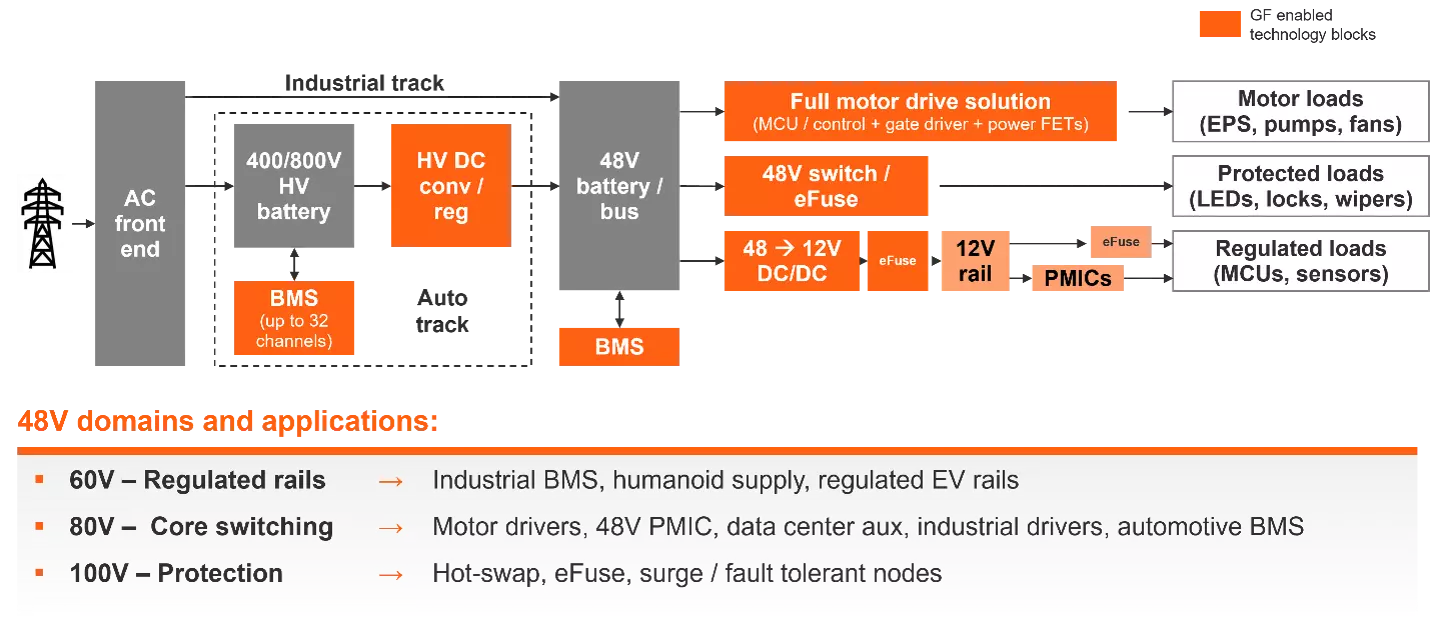
One common misconception is that a 48V system is a single-voltage design. A “48V system” spans the full power chain from an 800V AC front end all the way down to sub-1V point-of-load rails feeding processors. Within the 48V domain alone, a typical power IC must operate across multiple voltage regimes, including:
- 60V, for the regulated 48V supply rail
- 80V, for the core switching node, which is where most 48V power conversion actually happens
- 100V, for front-end protection against transients, inrush and fault events
Voltage rating alone is not enough to select the right power device. Different blocks also impose very different safe-operating-area requirements. GF’s 55BCD HV platform provides LDMOS options optimized for different operating conditions: Switching devices prioritize low on-resistance and switching efficiency, while Power and Scalable devices provide broader safe-operating-area capability for protection, pass/linear operation and high-voltage analog functions. This lets designers optimize each block for the right balance of efficiency, robustness and analog flexibility rather than forcing one transistor architecture across the entire 48V system.
55BCD HV: A smart-power foundation for 48V
Across automotive applications, industrial robotics and AI power-delivery systems, designers increasingly need to integrate sensing, protection and digital control into a single device. This level of integration reduces board complexity and enables more intelligent power-management architectures. GF’s 55BCD HV platform brings together several capabilities that are increasingly important as 48V power ICs become more integrated and intelligent.
- Broad voltage integration, 5V to 150V on one platform: Low-voltage digital control, mid-voltage analog sensing and high-voltage power stages can share the same die, cutting BOM cost, board area and system complexity. The DMOS suite covers 45-150V, with high-side operation reaching 165V and Deep Trench Isolation (DTI) supporting more than 200V. Combined with an N+ buried layer, DTI helps improve immunity to negative voltage transients, enabling noisy switching nodes to coexist with sensitive analog and digital blogs.
- Best-in-class HV device performance: Rsp is optimized across the 60V, 80V and 100V device families, the three workhorses of 48V power conversion, delivering up to 60% improvements in Rsp* (*compared to 130BCD).
- High digital density, >1 million gates per square millimeter: Built on a 1.2V core CMOS with LVT, RVT and HVT device options, the platform provides headroom and leakage control for local diagnostics, protection logic, communication interfaces like CAN-FD and SPI and embedded firmware. This puts system-on-chip architectures on a platform that previously may have required a pure-logic node.
- Automotive-grade reliability (AutoPro175): Qualified to AEC-Q100 Grade 0 at a junction temperature of 175°C, it gives automotive designers a pre-qualified platform that cuts qualification risk and time to market for under-hood and powertrain designs.
- Embedded NVM and a broad IP ecosystem: ESF3 embedded flash, SRAM, OTP/MTP, plus LVT/RVT/HVT standard cells, 5V GPIOs, memories and PLLs — the full toolkit for smart power SoCs with on-chip diagnostics and firmware storage.
- Manufacturing scale and resilience: 55BCD HV is supported by GF’s global manufacturing strategy, providing customers with a path toward greater, geographic supply flexibility.
- Modular by design: Customers pull only the mask layers, device families and IP blocks they need. Whether it’s a motor driver, a smart eFuse or a sensor SoC, each draw a different subset, right-sizing wafer cost and complexity to the product, so nobody pays for capability they don’t use.
Power GaN: the power density play
55BCD HV provides the intelligent integration, control and protection capabilities needed across many 48V systems, while Power GaN complements it where maximum switching frequency and power density are the priority. GF’s Power GaN portfolio addresses high-voltage conversion and selected 48V conversion stages, complementing 55BCD HV across the broader power-delivery chain.
GF’s differentiators
| Differentiator | What it means for 48V |
| Broad power portfolio | Complementary technologies spanning high-voltage conversion, smart-power integration and point-of-load delivery |
| Best-in-class switch performance | 44-60% Rsp reduction vs. prior node at critical 48V switching voltages (60/80/100V) |
| Automotive-grade reliability | High-temperature platform designed for demanding automotive and industrial environments |
| Geo-diversification | Minimizes supply chain risk — critical for automotive, aerospace & defense and hyperscaler customers |
| Integration & intelligence | About 1M gates/mm² digital density, ESF3 eFlash and a broad IP ecosystem that enables smart power SoCs beyond standalone power devices |
The next phase of 48V innovation
Looking beyond today’s deployments, next-generation 48V systems will require more embedded intelligence, more efficient memory integration, stronger transient robustness, enhanced high-voltage isolation and increasingly sophisticated functional-safety capabilities. GF continues to invest across these areas as the requirements for intelligent power systems evolve.
Contact your GF representative to learn more about development opportunities for 48V and 55BCD HV.