This is the second of a two-part series on the evolution of automotive networks
By: Yuichi Motohashi, Deputy Director of End Markets at GlobalFoundries
As vehicles move to Domain and Hybrid Zonal designs, sensors increasingly stream RAW or lightly processed data to a central platform, changing the communication requirement from exchanging control signals and recognition results to high-bandwidth, low-latency, high-reliability streaming. These sensor links are strongly asymmetric: high-resolution video, LiDAR point clouds and radar data flow uplink to the center, while only light configuration, synchronization, control and diagnostic data returns downlink.
SerDes (Serializer/Deserializer) fits this profile. It converts wide parallel sensor data into a high-speed serial stream over a clean point-to-point path, minimizing protocol overhead and latency, while bundling many signals into a few high-speed differential pairs or coaxial/shielded cables to simplify wiring. It also offloads the sensor, shifting recognition and fusion to the central SoC and enabling smaller, lower-power satellite sensors. Crucially, SerDes and Ethernet are complementary rather than competing. Ethernet suits multi-node automotive networks, while SerDes suits dedicated high-bandwidth links carrying sensor streams to the central SoC with low latency.
The rise of open-standard SerDes
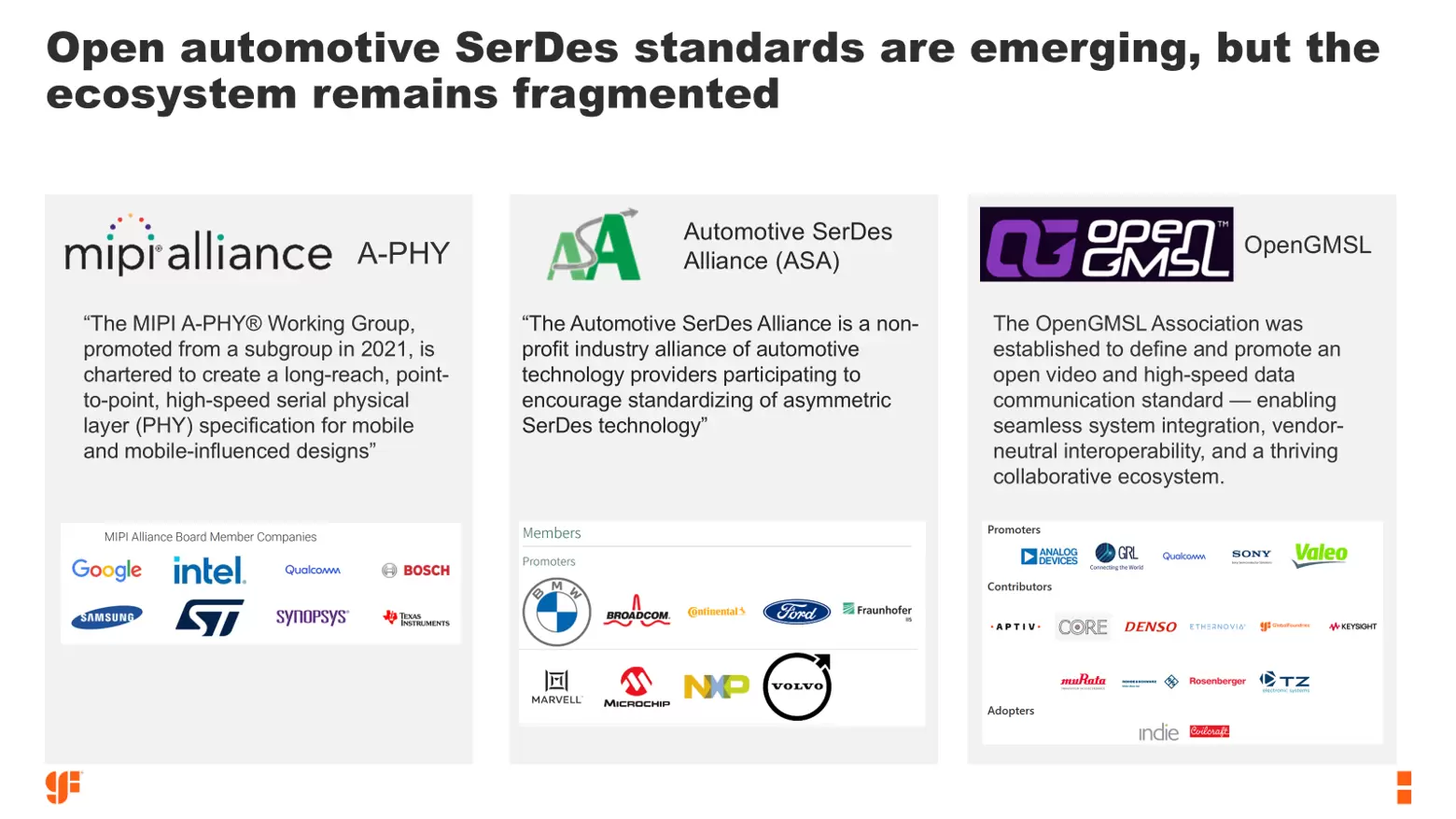
Automotive SerDes grew through proven proprietary technologies like TI’s FPD-Link, Analog Devices’ GMSL, Sony’s GVIF and Inova’s APIX. As SDV/Zonal vehicles mix more vendors, OEMs and Tier-1s want to combine components flexibly, reuse design assets across generations and broaden verification and procurement, driving open standardization:
- MIPI A-PHY is a long-distance asymmetric PHY that links the existing MIPI CSI-2/DSI-2 ecosystem to remote compute; adopted as IEEE 2977-2021.
- ASA Motion Link (ASA-ML) is an open, asymmetric SerDes for cameras, radar, LiDAR and displays Its ASA-MLE extension carries Ethernet packets over the link.
- OpenGMSL opens ADI’s GMSL track record to a multi-vendor ecosystem that GF is a part of.
- HSMT (QC/T 1217-2024) is China’s automotive high-speed media transmission standardthat uses NRZ/PAM4 and is designed for asymmetric sensor/display links.
The common thread is not replacing existing SerDes but building on it to add interconnectivity, scalability and design freedom for the SDV/Zonal era.
Bringing SerDes-like links into Ethernet/IP management
SerDes’ core value is efficient, low-latency point-to-point transport. The convergence trend adds Ethernet/IP-style manageability around those links; it doesn’t make SerDes and Ethernet the same technology. With that in mind, the next step is folding these asymmetric, uplink-heavy links into the Ethernet/IP model. The key framing is that the Zonal backbone is an Ethernet/IP-managed network, while high-bandwidth sensor links increasingly need asymmetric connectivity that pairs SerDes efficiency with Ethernet manageability. Once integrated, sensor connections gain IP addressing, switching, routing, QoS, TSN, time synchronization, diagnostics, security and OTA, all under a single management model spanning sensor, Zone Controllers, the Central Computer and even cloud coordination. Transitional approaches carry Ethernet frames over existing SerDes links like ASA-MLE or a bridge into an Ethernet network. Long term, physical wiring is organized per zone while logical management converges on IP/Ethernet progressing in stages according to vehicle type, bandwidth, cost and reliability.
Beyond the speed-up from copper to optical
As sensor counts, resolution and compute performance rise, copper faces limits in signal loss, equalization, power, heat and EMI/EMC. This is compounded by automotive constraints on temperature, vibration, lifespan and connector reliability. To address this, optical communication is emerging as a future option. While it’s not mainstream today, it is a a technology entering standardization, exemplified by IEEE 802.3cz-2023 multi-gigabit glass-optical automotive Ethernet (2.5G to 50GBASE-AU). Optical fiber offers high bandwidth, low susceptibility to and generation of EMI and weight savings which are attractive for high-speed Zonal backbones and inter-compute links. Though it’s important to note that automotive temperature, vibration, connector durability, long-term reliability and cost remain hurdles, so adoption will likely be staged from the highest-bandwidth applications first. Silicon photonics, which integrates optical functions on silicon alongside CMOS, is a key enabler for compact, low-power, high-reliability automotive optical I/O.
The silicon behind It: a wafer-technology view
Every step of this evolution raises the bar for the silicon underneath requiring high-frequency performance, low power, low noise, reliability and long-term supply. GF offers a broad technology portfolio relevant to automotive SerDes/PHY, Ethernet PHY and Zonal/Domain Controllers, while silicon photonics provides a starting point for future automotive optical I/O:
- SerDes/PHY is scaling toward the 6/12/24 Gbps class and beyond, requiring balanced high-Ft/Fmax transistors, low-noise analog and digital density — served by 40LP AutoPro, 22UX, 22FDX and 12LP/12LP+ FinFET.
- High-speed Ethernet PHY, including the 10 Gbps class, serves the Zonal backbone and works best on feature-rich CMOS, FDX and FinFET/RF platforms.
- GF supports open SerDes as a member of the OpenGMSL Association. Silicon photonics as a starting point for future automotive optical I/O.
- A three-continent manufacturing footprint across the US, Europe and Singapore combined with the AutoPro™ automotive-quality framework, helps customers manage long-term supply and geopolitical considerations.
Summary: When the network changes, the silicon changes too
As SDV, autonomous driving, sensor fusion and Zonal-ization advance together, the volume, direction and meaning of in-vehicle data shifts along with semiconductor requirements. Across the four axes:
- Sensors move from smart to satellite.
- Data moves from extracted results to RAW or lightly processed sensor-specific streams and eventually to integrated environmental models.
- Compute moves from distributed ECUs to Domain Controllers to the Central Computer.
- Network moves from CAN/LIN/FlexRay and 100 Mbps Ethernet to SerDes sensor links and an Ethernet/IP Zonal backbone, then to asymmetric connectivity that folds SerDes into Ethernet/IP and eventually to optics.
SDV is often told as a software story, but behind it sits the silicon that gathers, carries, processes and continuously updates vast amounts of data. This is the true foundation of the next-generation automotive architecture.