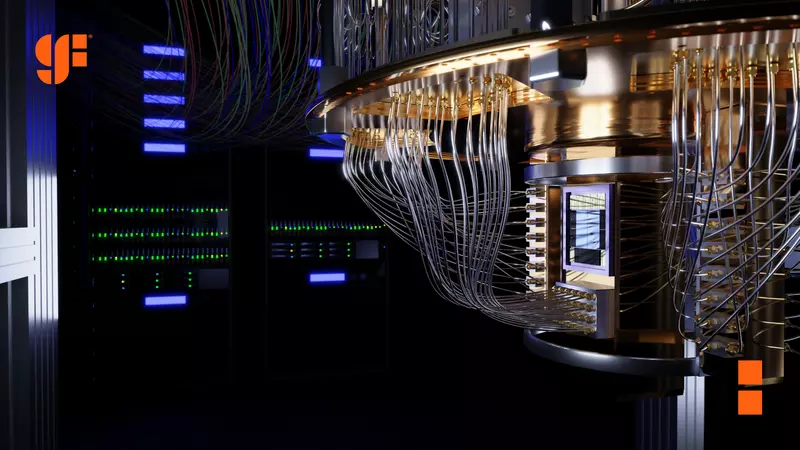









How GlobalFoundries is manufacturing quantum at scale April 14, 2026 Quantum computing is no longer science fiction confined to the lab. It is a new computing paradigm with the potential to solve problems beyond the reach of classical systems. From simulating complex molecules for new drugs to discovering new materials, quantum computers will transform entire industries. But building quantum computers at scale requires more than brilliant ideas. It demands world-class semiconductor manufacturing expertise. That’s where GlobalFoundries (GF) plays a critical role. As the leading specialty foundry, GF is uniquely positioned to accelerate the quantum revolution, no matter which hardware approach ultimately wins. What is quantum computing? Quantum computing harnesses the three rules of quantum mechanics: superposition (a qubit can exist in multiple states at once), entanglement (qubits can be linked so the state of one instantly influences another) and interference (which amplifies the probability of correct answers while canceling incorrect ones). While a classical bit can exist only as a 0 or a 1, a qubit can exist in a superposition of both states at the same time until it is measured. When many qubits are combined, the system is described by an exponentially large set of possible states, represented mathematically as amplitudes – a property often referred to as quantum parallelism. A sequence of quantum gates transforms those amplitudes, but when the computation is measured, it still produces only a single result. The practical advantage of quantum computing comes from algorithms that harness quantum interference to increase the probabilities of correct answers while suppressing incorrect ones, thereby increasing the likelihood of obtaining a useful result, for example, through amplitude amplification techniques that generalize Grover-style speedups. Quantum computers are therefore best viewed as special-purpose accelerators. They outperform classical systems on specific problems such as simulating quantum systems, structured search, sampling, or extracting global properties, while complementing classical computers for everyday workloads. A gamechanger for industries The impact of quantum computers with sufficiently capable qubits will be profound: Pharmaceuticals and life sciences: Accurate molecular simulations could slash drug discovery timelines from years to months. Finance: Quantum algorithms will revolutionize portfolio optimization, risk modeling, fraud detection and derivative pricing, for faster and more accurate insights in volatile markets. Logistics and supply chain: Real-time optimization of routes, inventory and manufacturing schedules could cut costs dramatically and improve resilience. Materials science and energy: Direct modeling of complex quantum interactions among electrons could accelerate the design of breakthrough materials such as superconductors, advanced batteries, photovoltaics and solid-state electrolytes. AI and machine learning: Quantum-enhanced models promise breakthroughs in pattern recognition and generative AI. Cybersecurity: While quantum computers threaten current encryption (prompting the shift to post-quantum cryptography), they also enable ultra-secure quantum key distribution. McKinsey and others estimate the value of quantum computing at tens to hundreds of billions of dollars annually once systems with a few hundred to a thousand logical qubits (the error-corrected units needed for reliable computation) become available. The question isn’t if-it’s when and how fast we get there. The road to scale: Manufacturing and the modality challenge Quantum computing is entering a new phase. The question is no longer whether qubits can work in a lab, but how complete quantum systems will be manufactured and scaled reliably for real-world deployment. Today, there is no industry-wide alignment on a single qubit modality. Leading approaches include superconducting circuits, trapped ions, photonic qubits, silicon spin qubits, neutral atoms, topological qubits and others. Each has distinct strengths and trade-offs in terms of fidelity (accuracy of quantum operations), coherence (how long the qubits retain their “quantumness”), scalability (how many qubits can you cram into a system) and operating temperature. This diversity is healthy and drives innovation, but it also means the ultimate winners will be those who can manufacture at volume- reliably and at reasonable cost- regardless of which architecture prevails. That is exactly where GF’s semiconductor expertise gives the quantum ecosystem its strongest foundation Why GF is the best partner-across any modality Given the uncertainty around which qubit modalities will ultimately prevail, the critical challenge for the industry is not proving isolated devices in the lab, but enabling repeatable, high‑yield manufacturing with a clear path to volume production. Rather than betting on a single qubit technology, GF takes a manufacturing‑first approach to quantum computing – building scalable, configurable semiconductor platforms that can support a wide range of quantum architectures as they mature. That is where GF’s role in the quantum ecosystem is fundamentally different. GF’s strategy is rooted in leveraging existing, qualified semiconductor platforms and extending them, where needed, to meet emerging quantum requirements. This approach dramatically reduces development risk, cost and time compared to building bespoke, one‑off processes for each modality. It also enables quantum teams to anchor their roadmaps to technologies that are already proven in high‑volume manufacturing environments. Across modalities, quantum systems increasingly converge on a common set of manufacturing needs: tight process control, materials uniformity, integration of electronics and photonics, ultra‑low‑noise interfaces and advanced packaging to combine heterogeneous components. These requirements align directly with GF’s core strengths as a specialty foundry. GF brings together: FD‑SOI technologies such as 22FDX®, which are actively being explored by the quantum community for tightly integrated classical control, readout and system‑on‑chip architectures High‑voltage and RF‑capable platforms, enabling power delivery, signal generation and amplification functions that are increasingly critical as quantum systems scale Advanced heterogeneous integration and packaging, allowing quantum processors, control electronics, photonics and interconnects to be combined into manufacturable system‑level solutions Silicon photonics platforms on 300 mm wafers that form a scalable foundation for photonic quantum systems as well as optical interfaces Importantly, GF enables R&D, prototyping and early‑stage quantum development on the same industrial manufacturing infrastructure used for volume production. This continuity helps quantum system developers avoid costly transitions between research fabs and production fabs – a challenge that has historically limited scalability in emerging technologies. As quantum computing progresses from experimentation toward deployable systems, manufacturability will increasingly determine which architectures scale, and which do not. By remaining technology‑agnostic and focused on extensible, reproducible manufacturing platforms, GF provides a stable foundation for innovation across superconducting, photonic, spin‑based, atomic and hybrid quantum approaches. In a field defined by architectural uncertainty but united by the need to scale, GF’s role is not to choose winners – but to enable them.
Powering AI at scale: How HVDC and GaN are transforming hyperscale data centers April 1, 2026 By Tim Nutt This article was originally published on EDN and is republished here with permission. Read the original article on EDN. The rapid adoption of artificial intelligence (AI) across consumer and commercial markets is driving unprecedented investment in high-performance computing and networking. As AI models scale and proliferate across diverse applications, demand for compute power keeps rising. To meet this need, the power consumption of heterogeneous processing units (XPUs) is projected to climb from today’s 1–1.5 kW to more than 5 kW by 2030 [1]. This surge in power requirements is driving demand for denser, more efficient power conversion solutions from grid to core. The emerging power distribution architecture enabling AI scale Distribution of 415-480 VAC within datacenters causes a patchwork of electrical conversions. AC power needs to be converted to DC power to support battery backup, and back to AC for further distribution. But as AI systems scale up, this energy loss is too costly to absorb. A key focus area for the industry is high voltage direct current (HVDC) distribution which reduces conduction losses, as well as the number of conversion stages across large clusters. The main proposed solutions are either ±400 V (Mt. Diablo) or 800 V (Kyber) DC power delivery. The first phase of HVDC solutions will still rely on 415-480 VAC distribution with a sidecar power rack, thereby reducing some power conversion losses. This step has fewer power conversion stages than existing systems and reduces conduction losses by delivering HVDC to the adjacent compute rack. However, to further eliminate power conversion stages, data centers will distribute HVDC throughout the cluster. Additional energy savings will be achieved by implementing the 800V DC-DC conversion within the system trays in compute racks, reducing busbar conduction losses. This deployment will require a significant step up in density and efficiency. The past few months have seen hyperscalers specifying their general needs [2] of higher rack-power capacity, power efficiency, density and scalability, as well as vendors responding with proposed converter topologies and considerations to meet those needs [3]. This marks real progress, and it’s already clear that the key performance goals of the solutions are within reach. The benefits of these next-generation power delivery architectures include: High conversion ratio – Conversion from HVDC distribution to very low XPU core voltage with as few stages as possible requires a large step down ratio (>1000:1). Solutions based on wide bandgap semiconductors such as gallium nitride (GaN) achieve higher conversion ratios due to higher breakdown voltages and reduced conduction and switching losses compared to silicon-based solutions. Significant density increase compared to current power supply unit (PSU) designs – The increase in XPU power consumption does not come with a corresponding increase in available volume for power electronics. Computer and network architectures impose a constraint on physical distance, creating a need for more compact power components. Thanks to their excellent switching characteristics, GaN power semiconductors can support higher frequency operation, allowing smaller energy storage components such as capacitors and inductors or transformers. Extremely high efficiency at scale – The extraordinary growth in datacenter power consumption means that power losses in every stage translate directly to energy costs. Thus, the conversion ratio and high density must be achieved without sacrificing efficiency. GaN devices offer the best figures of merit – including including lower specific on-resistance, minimal switching charge, and better high-frequency FOM – which result in the highest efficiency for a given ratio and density. How GaN is driving datacenter innovation The datacenter market demands not only advanced performance but also exceptional quality and reliability. Increasingly, industry consensus points to Power GaN as the key enabling technology for HVDC solutions in data centers. GlobalFoundries is developing GaN platforms to support this transition, including HV (650V) and MV (200V and below) devices. These platforms will offer industry leading figures of merit with the reliability and ruggedness that hyperscalers require to deploy AI at scale. Opportunities for Scaling HVDC ArchitecturesLooking ahead to broad solution deployment, there are several major opportunities that remain, each offering room to drive the next wave of innovation on topology selection and device optimization: Establishing clear safety and isolation requirements: To date, safety and isolation have been discussed only in broad terms, but HVDC architectures will require isolation. Achieving safety and isolation compliance through spacing (creepage and clearance) can come at a significant cost to density, while achieving compliance mechanically via conformal coating or potting can degrade thermal performance – both of which complicate serviceability of systems in the field. Defining the right balance represents a major opportunity for innovation in materials, mechanical structures, and system architecture. Defining EMI/EMC requirements for scaling next generation datacenters: With datacenters requiring strict electromagnetic interference (EMI) and electromagnetic compatibility (EMC) standards, the industry must determine how topologies can meet them. If bulky filter components are required to scale HVDC solutions, this may prevent density targets being met, potentially forcing alternate topology selection. It is crucial that these requirements scale to multi-GW datacenters allowing clusters to interoperate, otherwise compatibility and performance are at risk. Converging on optimal step-down ratios and system-level power conversion strategy: Will the industry converge to a 16x or 64x step-down or, as the HVDC converter moves into the system tray, will system designers optimize the power conversion stages around different voltage levels? If solutions are customized based on system-level optimization, this will likely lead to a need for regulated HVDC converters as well as unregulated fixed-ratio, with the two types having distinct transient requirements. These tradeoffs will affect overall system design in the future, from rack input to XPU. Enabling Scalable, Efficient, and Sustainable Datacenters As these solutions evolve and mature, GF will collaborate with our customers to optimize device development, integrate driver and sensor functionality with power devices, and heterogeneously integrate power devices with additional components. It is encouraging that along with the activity around converter feasibility, industry participants are also extremely active in pursuing open standards, such as the Open Compute Project’s Power Distribution sub-project, which will provide a roadmap for scalable, interoperable HVDC architectures. Adoption of HVDC architectures allows operators and OEMs to convert efficiency gains directly into XPU and network-cluster performance — delivering more usable Floating-point Operations Per Second (FLOPs) from the same energy footprint while reducing energy losses, lowering operational costs, improving rack-level density, and advancing sustainability goals through more efficient power delivery. Meeting these stringent demands at massive scale requires solutions that ensure interoperability and long-term ecosystem value remain top priority. Anmerkungen: [1] Future AI processors said to consume up to 15,360 watts of power — massive power draw will demand exotic immersion and embedded cooling tech | Tom’s Hardware [2] Asset Share – NVDAM [3] Swing Aboard the 800-V Bus: NVIDIA’s AI Power Architecture and the Chips to Drive It | Electronic Design
GlobalFoundries Files Patent Infringement Lawsuits Against Tower Semiconductor to Protect High-Performance American Chip Innovation March 26, 2026 Multiple U.S. patent lawsuits filed to halt unlawful importation and sale of semiconductors infringing GF’s patented technologies MALTA, N.Y., March 26, 2026 — GlobalFoundries (Nasdaq: GFS) (GF), a leading American semiconductor manufacturer, today announced that it has filed multiple lawsuits in the U.S. against Tower Semiconductor Ltd. alleging that it has infringed GF patents by freeriding on decades of GF innovation with an intent to unlawfully take business away from the American chipmaker. The lawsuits were filed today in the U.S. International Trade Commission (ITC) and the United States District Court for the Western District of Texas. The complaints allege that Tower, a competing semiconductor manufacturer, unlawfully uses GF’s patented manufacturing process technologies, engaging in unlicensed exploitation of GF’s R&D investments rather than undertaking the costly, long-term research required to develop these capabilities independently. The actions assert infringement of 11 GF U.S. patents protecting high-performance technologies critical to smart mobile, automotive, aerospace and communications infrastructure, and seek injunctive relief to block Tower’s importation and sale of infringing products in the U.S. as well as to compensate GF for any lost profits. “Semiconductor manufacturing is one of the most complex and capital-intensive industries in the world,” said Gregg Bartlett, chief technology officer at GF. “There is no shortcut to real innovation. Companies that attempt to extract value from patented process technologies without authorization or investment undermine fair competition and the integrity of the semiconductor ecosystem. Our actions are necessary to defend our intellectual property, protect the innovation that underpins it, and to ensure that competitors play by the same rules.” GF has made sustained investments in domestic semiconductor manufacturing and research and development for more than a decade, building a robust global intellectual property portfolio rooted in U.S. innovation. In June 2025, GF committed up to $16 billion in additional U.S. fab investments, including approximately $3 billion dedicated to R&D in emerging semiconductor technologies. GF has built a strong portfolio of over 8,000 patents through sustained innovation, deep process expertise and decades of proprietary know-how, while Tower has less than 500 patents, and the company will vigorously enforce its intellectual property rights in support of a vibrant semiconductor manufacturing industry for the benefit of its customers. About GF GlobalFoundries (GF) is a leading manufacturer of essential semiconductors the world relies on to live, work and connect. We innovate and partner with customers to deliver more power-efficient, high-performance products for the automotive, smart mobile devices, internet of things, communications infrastructure and other high-growth markets. With our global manufacturing footprint spanning the U.S., Europe and Asia, GF is a trusted and reliable source for customers around the world. Every day, our talented global team delivers results with an unwavering focus on security, longevity and sustainability. For more information, visit www.gf.com. Forward-looking Information This news release may contain forward-looking statements, which involve risks and uncertainties. Readers are cautioned not to place undue reliance on any of these forward-looking statements. These forward-looking statements speak only as of the date hereof. GF undertakes no obligation to update any of these forward-looking statements to reflect events or circumstances after the date of this news release or to reflect actual outcomes, unless required by law. Contacts: Erica McGill GlobalFoundries [email protected]
Flexcompute and GlobalFoundries Enable Integrated Design and Simulation on GF Silicon Photonics Platform March 18, 2026
Luceda Photonics and GlobalFoundries Announce Strategic Collaboration to Deliver Luceda PDK, Accelerating Silicon Photonics Innovation March 18, 2026
EXFO’s Industry-leading Innovations Supporting AI Infrastructure from Chip to System to Data Center Exhibited at OFC 2026 March 16, 2026
Siluxtek has collaborated closely with GlobalFoundries to jointly promote the Mass-Produce 200G/Lane Silicon Photonic Receiver Chips March 16, 2026
Lightwave Logic High-Speed Modulator Platform Now Available in GDS Factory PDK for GlobalFoundries Silicon Photonics Platform March 16, 2026